Official Game Rules & Simulation Guide
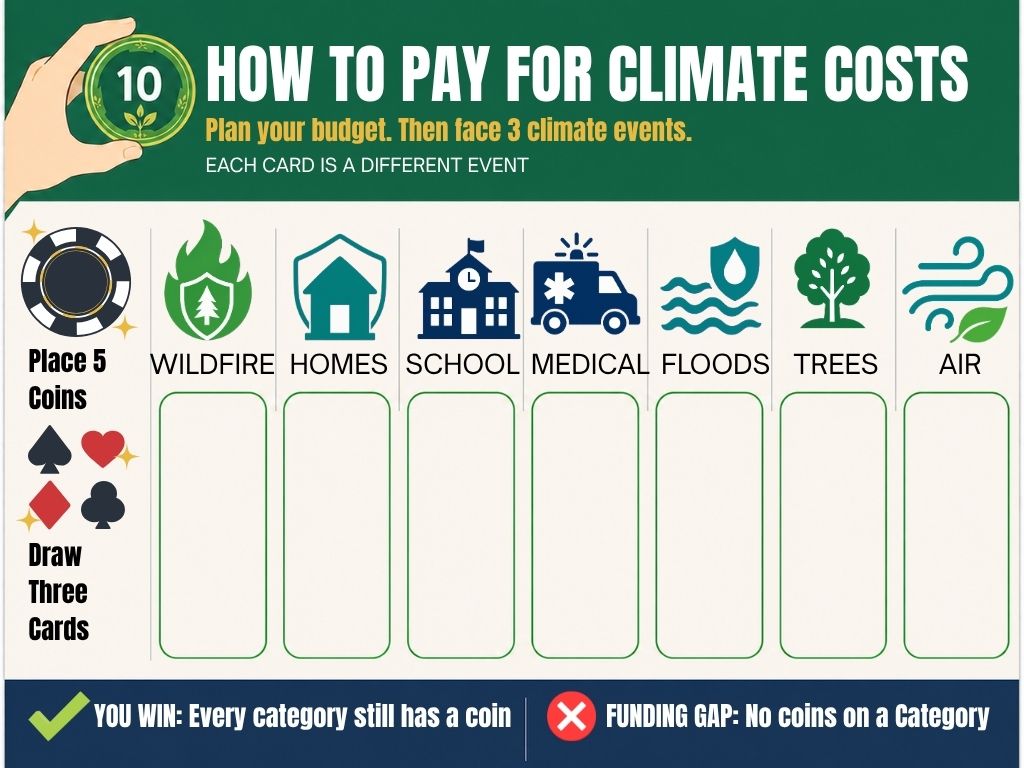
How to Pay for Climate Costs is a brief educational simulation highlighting the severe economic pressures local governments face during climate disasters. Players act as city budget administrators forced to allocate limited public funds across seven vital infrastructure sectors before confronting unpredictable, high-severity climate events. Play the interactive version above, or use the rules below to run the game with a physical board, coins, and printed event cards.
Objective
Survive three climate event cards while maintaining funding across all seven infrastructure categories. Players must balance equal distribution versus deep protection to avoid leaving any sector with zero funding.
Components
- 7 Category Buckets: Wildfire, Homes, School, Medical, Floods, Trees, Air.
- Budget Tokens (Coins): Physical markers representing municipal funding units.
- Event Deck: Climate disaster cards indicating sector targets and required severity costs.
Setup
Place the seven Category Buckets side-by-side on the table. Shuffle the Event Deck and place it face down. Determine which game variant is being played (Round 1: 8 Tokens, or Round 2: 12 Tokens) and distribute tokens to players.
Starting the Game
Budget Allocation Phase: Players receive their starting Budget Tokens and must distribute all tokens across the seven category buckets on the board before drawing cards.
Note: You may place multiple tokens into a single category or leave categories empty. Any category with 0 tokens is completely unbuffered and exposed.
Climate Events & Resolution
Draw three Event Cards sequentially from the deck. Each card identifies a target category and a Severity Cost (1, 2, or 3 tokens). Compare the required cost with the placed tokens:
- Sufficient Coverage: If tokens equal or exceed the cost, discard tokens equal to the card's cost from that category.
- Funding Gap: If tokens are fewer than required (or 0), an immediate infrastructure failure occurs.
Winning and Losing the Game
- Victory (Climate Resilience): You survive all 3 Event Cards AND every single category still has at least 1 token remaining.
- Failure (Funding Gap): You fail immediately if any category drops to 0 tokens, either during initial placement or after resolving an event card.
Rule Clarifications
If an event card requires 2 tokens in FLOODS, but FLOODS only has 1 token, the entire 1 token is lost and the game results in an immediate Funding Gap failure.
Alternate Rules (Two-Round Mode)
To highlight systemic funding mechanisms, play the game in two distinct sequential rounds:
- Round 1 (Local Budget Only — 8 Tokens): Players attempt to cover 7 buckets with only 8 tokens, leaving almost no buffer against a second or third event hitting the same sector.
- Round 2 (Climate Superfund — 12 Tokens): Players receive 8 local tokens plus 4 Superfund tokens (polluter accountability & federal grants), giving every sector real breathing room against severe events.
An Example of Play
Round 1 Example
Players start with 8 tokens and place 2 in Wildfire (their top perceived risk), 1 token each in Homes, School, Medical, and Floods, and stretch their budget by leaving Trees and Air with 0 tokens. They draw Card 1: "Extreme Heat (Requires 1 Token in Air)." Because Air has 0 tokens, a Funding Gap occurs instantly, ending the round in failure.
Round 2 Example
With 12 tokens, players place 3 in Floods, 3 in Wildfire, 2 in Homes, 1 in School, 1 in Medical, 1 in Trees, and 1 in Air. Card 1 drawn: "Catastrophic Flooding (Requires 2 Tokens in Floods)." Two tokens are removed from Floods, leaving 1 behind — Sufficient Coverage, with a buffer still in place for the next event.
Discussion Notes
Discuss which sectors were sacrificed in Round 1 and how external federal and Superfund resources altered budget strategy in Round 2. This simulation is designed to give students a tangible, low-stakes way to explore the trade-offs local governments face when climate disasters outpace available funding.